Because There Is No
Substitute for Experience,
Knowledge & Advocacy
Substitute for Experience,
Knowledge & Advocacy







Nobody, and certainly your attorney, should care about who you date or how you identify in terms of gender or sexuality. However, for many high net worth individuals, executives, physicians, lawyers, public officials, entertainers, athletes, and others whose reputation has real monetary and personal value, sextortion by a transgender man or woman can be far more than a digital nuisance, an embarrassment, or even the dollars you have already paid or are willing to pay your blackmailer. As one of a very few lawyers experienced in shutting down extorters, the real or perceived added shame of these private relationships often send clients spiraling and give their abusers the upper hand. Whether from a transgender hookup or longterm but secret relationship born from MyTransgenderDate.Com, BedPage.Com, OKCupid.Com, TGPersonals.Com, Tryst.Link, KinkyPeopleMeet.Com, Fling.Com or one of countless other sites, when a sextortion involves a transgender partner, you need to shut down your harasser before life goes from bad to far, far worse.
Any sextortion is a crisis that can threaten your privacy, family life, employment, professional licenses, investor confidence, and public standing in a matter of hours. When the scheme begins on a transgender dating platform or in a trans-inclusive online community, the fear can become even more intense because many victims, no different than you, believe the extortionist is counting on embarrassment, stigma, or the risk of public misunderstanding to force immediate compliance.
That fear and weaponization is precisely what makes these schemes work.That is, of course, until you step back, pause, and rationally think your situation through and get the legal guidance and real world help you need.
Saland Law represents people facing sensitive criminal and quasi-criminal crises in New York City and well beyond. The firm is headed by Jeremy Saland, a former prosecutor and New York criminal defense lawyer who understands how to move quickly, preserve leverage, assess risk, and build a legal strategy without making an already dangerous situation worse. Whether you or your stalker are in New York or even abroad in Eastern Europe or somewhere in Asia, if you are being threatened after using an app or site such as Taimi,HER, or any of those mentioned above among many others, we have one goal: protecting you now and in the future. The objective is not to create a public spectacle or put you at risk. It is to stop the abuse, protect your identity, preserve evidence, reduce exposure, and position you to act from strength instead of panic. We have done this time and time again, and we can do it for you if you are ready to take control of a bad situation before it upends your world as you know it.


Sextortion schemes tied to transgender dating can be particularly vicious because the perpetrator often assumes the victim will pay to avoid disclosure. In some situations, the threat is not limited to sharing intimate images. The extortionist may threaten to expose chats, profile screenshots, “dick pics”, private fantasies, voice notes, photos, workplace information, family information, or allegations designed to destroy a marriage, career, or public reputation.
Sometimes the threat is explicit. Other times it is framed more subtly. The blackmailer may say they will “tell your employer,” “send everything to your wife,” “put this online,” “report you,” or accuse you of wrongdoing even when the communications were consensual, incomplete, manipulated, or fabricated. In that sense, the scheme is not only about sex. It is about pressure, narrative control, and fear.
For public facing professionals, the pressure is often multiplied by timing. The extortionist may target you just before a board meeting, political event, media appearance, court hearing, fundraising campaign, or family event. They want you rushed, isolated, ashamed, and willing to send money before you have the chance to think clearly or retain counsel.
Many transgender dating sextortion matters start on legitimate platforms that serve LGBTQ+ and trans users. Other times, the first communications come from sites that are “pay to play”. For example, Taimi describes itself as a fully inclusive LGBTQ+ dating app, and HER markets itself as a queer dating and community platform that includes trans and nonbinary users, with identity-based filters, profile tools, and community features. Those kinds of features can be positive for authentic users looking for real connection. They can also be exploited by bad actors who know exactly how to mirror language, identity, tone, and expectations in order to build false trust.
Sugarbaby and sugardaddy dynamics can create an additional layer of vulnerability in these cases. Some scammers deliberately present themselves as admirers, or attractive younger companions seeking a discreet arrangement. They may frame the relationship as a mutually beneficial sugarbaby or sugardaddy connection, then use flirtation, sexual promises, gifts, or lifestyle talk to accelerate intimacy and lower the victim’s guard. Once private photos, messages, or explicit conversations are exchanged, the scam can shift abruptly from fantasy and secrecy to coercion and threats.
A typical scenario unfolds quickly. You connect with someone who seems responsive, attractive, emotionally open, engaged and eager to move the conversation off platform. Alternatively, you both are quite clear that the relationship, or lack thereof, is brief and intimate. Within minutes or hours, the chat shifts to texting, encrypted messaging, social media, video, or disappearing content. The person may claim to be a trans woman, trans man, nonbinary person, or someone specifically looking for T4T or trans-inclusive dating. They may flatter you, mirror your interests, and create a false sense of exclusivity. In the end, whatever the nature of the relationship, it feels safe even if merely somewhat so.
Then the turn comes.
You are asked for a photo, a video, a live chat, a screen share, or a sexually explicit exchange. In some cases, the extortionist is not even the person in the profile. It may be a criminal ring using stolen images, prerecorded clips, or a fake account. In other cases, the extortionist may actually engage in a real-time interaction and record it without your knowledge. Once they believe they have enough material, the affectionate tone disappears and the demands begin.
Your sextortionist is not relying only on the image or message itself. They are weaponizing the meaning they think the material has in your life, and they know fear has value
If you are married, they may threaten disclosure to your spouse. If you are a lawyer, doctor, banker, educator, or licensed professional, they may threaten to contact your firm, hospital, agency, or licensing board. If you are in politics or media, they may threaten the press, donors, opposition researchers, or anonymous online accounts. If you are a parent, they may threaten to send material to your children’s school community or other families.
In transgender dating matters, a bad actor may also try to exploit fears relating to identity, orientation, privacy, or public assumptions. Some victims are openly supportive of LGBTQ+ communities and still fear personal humiliation. Others are not publicly open about their private life. Others worry, with good reason, that an extortionist will distort consensual conduct into a false accusation. Even if those allegations are meritless, their potential impact can be enormous.
That risk can become even more pronounced when the communications have a “pay to play” element. In some situations, the extortionist will leverage your interactions into money, gifts, travel, or financial support. If you paid or offered to pay for attention, companionship, explicit content, or an in-person meeting, then you will pay them to keep their mouth shut whether you followed through and consummated anything or not. Even where the exchange began as consensual adult communication, a blackmailer may later weaponize that “pay to play” theme by threatening to mischaracterize the arrangement, publish selective screenshots, or portray the victim in the most damaging light possible to a spouse, employer, licensing authority, or the public.
That is why the response cannot be improvised. That is why you need professional guidance. That is why you need to change the power dynamic and seize control.
Victims often ask the same question first: should I just pay and make it go away? Alternatively, they have already paid and wonder if they should pay again.
Usually, if not always, no.
Payment often confirms to the extortionist that you are vulnerable, financially capable, and frightened enough to comply. Once that happens, the demand frequently increases. A demand for one payment becomes a demand for five. A promise to delete content becomes a threat to release backup copies. An agreement to stop becomes a new scheme involving “taxes,” “verification fees,” “silence fees,” or demands for additional sexual content. Sometimes it’s couched as a “boss” demanding more money. Sometimes the extortionist simply threatens him or herself. Either way, you lose when you pay.
In cross-border or organized online sextortion cases, the person messaging you may be only one member of a broader ring. That means even if one actor stops communicating, the material, screenshots, contact list, and leverage may remain in circulation. Payment can also complicate later investigative options and does not guarantee privacy.
The better question is not how to appease the blackmailer. It is how to contain the threat, preserve evidence, reduce avenues of attack, and decide which legal and strategic tools will actually protect you.
First, the evidence has to be preserved before anything disappears. That can include usernames, profile links, message threads, timestamps, payment demands, crypto wallet addresses, cash transfer instructions, call logs, screenshots of threats, images used by the extortionist, and lists of threatened recipients. In some cases, metadata, device records, cloud accounts, or business system logs matter as well.
Second, the communication strategy must be controlled. Some victims send emotional replies, make promises, or argue with the perpetrator. That often gives the extortionist more material to exploit. A lawyer-guided approach is different, assuming, of course, that lawyer has practical and real world experience in these delicate and sensitive matters. Jeremy evaluates whether direct communication should stop, continue in a limited evidence-gathering way, or shift to a more formal preservation and pressure strategy. Either way, he becomes your voice.
Third, exposure points need to be assessed. That may include your spouse, employer, public relations team, executive assistant, law partners, compliance officers, family office, or security personnel. Not every case requires disclosure to anyone. But pretending there is no risk can be just as dangerous as overreacting. The key is thoughtful containment.
Fourth, any overlap with criminal exposure, civil liability, false allegations, workplace duties, or mandatory reporting concerns must be reviewed immediately. A victim of extortion can still end up needing counsel to protect against a distorted or fabricated accusation.
Many sextortion schemes are not local. The account may appear to be in New York while the operator is in another state or another country entirely. Payment demands may move through cryptocurrency, money transfer apps, mule accounts, or shell identities. Photos may be stored on foreign servers or bounced through multiple platforms.
Cross-border complexity does not mean you are powerless. It means the response must be realistic.
The law may still apply if the threats reached you in New York, targeted your reputation or property, or used interstate or foreign communications. Even where prosecution is uncertain or slow, counsel can still help you preserve evidence, coordinate with the right agencies when strategically appropriate, evaluate platform reporting measures, address impersonation, prepare for targeted takedown efforts, and reduce the chances that panic will lead to a damaging mistake. Remember, the threat of prosecution may be inconsequential and unrealistic. Hitting your abuser where it counts – their bank accounts and means to perpetrate their fraud against you and others – is often the more viable and powerful approach.
For many professionals, the goal is not theatrical justice. It is intelligent damage control, with as much confidentiality as possible, along with terminating the threat through any legal means possible. Convincing your sextorter that if they do not cease something wicked this way comes for them and their finances within the four corners of the law is the task at hand and one Saland Law has achieved countless times before
Every platform has its own culture, features, and vulnerabilities. On apps and sites that openly welcome transgender users, scammers may exploit the very things that make the platform feel safer and more affirming. They may misuse identity labels, community language, pronouns, profile verification expectations, private groups, or niche search functions to appear credible. Those features can help legitimate people find connection, but they also create opportunities for highly targeted impersonation.
That is one reason victims should avoid assuming that a trans-focused or trans-inclusive environment automatically eliminates risk. The problem is rarely the platform alone. The problem is the individual or ring that learns how to use the platform’s culture as camouflage.
The same is true when a scammer tailors the approach around sugarbaby or sugardaddy expectations. A fraudster may study the language of discreet arrangements, luxury support, allowance conversations, or “pay to play” exchanges and then use that vocabulary to appear credible. That kind of targeting is effective because it creates a sense of privacy and exclusivity while also giving the extortionist material they can later twist into a threat. In other words, the scammer is not just stealing images or messages. The scammer is building a narrative designed to maximize embarrassment and pressure.
Deleting chats, account histories, or payment records may feel emotionally satisfying, but it can destroy evidence that later helps identify the perpetrator or defend you against false claims.
Once a demand is made, casual back-and-forth usually benefits the extortionist more than the victim. Each response gives them more information about your fear, schedule, resources, and priorities.
Some blackmailers bluff. Others do not. Until the risk is properly assessed, treat the threat as real.
Waiting because you hope it will fade away can be costly. Quiet action taken early is often more effective than loud action taken late.
These cases often sit at the intersection of criminal law, privacy, and reputational harm. A person being extorted may also need advice about employment duties, internal reporting rules, media exposure, family issues, or potential civil remedies. For a lawyer, physician, or financial executive, one bad decision can create a second crisis independent of the original sextortion.
That is why counsel matters. The legal problem is not just, “someone is threatening me.” It may also be, “how do I protect my license, my family, my business, and my name while avoiding unnecessary visibility?” A former prosecutor brings a practical understanding of how evidence, credibility, leverage, and timing shape the outcome. In many matters, the first objective is to slow the situation down and stop the blackmailer from dictating events.
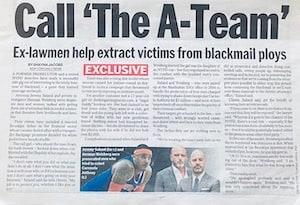
Saland Law approaches transgender dating sextortion schemes with the seriousness they deserve. These are not embarrassing side issues. There is no judgment and should be no judgment on your preferences or orientation. They are high-stakes coercion matters that can implicate New York crimes, federal offenses, financial frauds, cross-border evidence, false allegation risk, intimate image exposure, and severe reputational harm. Jeremy Saland’s background as a former prosecutor who was the lead attorney on the investigation, indictment and conviction of four individuals extorting a then NBA Allstar, informs a disciplined response focused on evidence preservation, legal positioning, and strategic decision-making aimed directly at your violaters ability to perpetrate his or her crimes.
If you are a public facing or high net worth professional, you may not want publicity, delay, or amateur advice from people who do not understand how quickly an online threat can spiral. You may need a lawyer who can assess the conduct, identify the statutes in play, evaluate whether law enforcement involvement helps or hurts at a particular stage, and build a plan centered on quiet control rather than public drama.
When you are being threatened over communications tied to a transgender dating or trans-inclusive platform, the goal is not simply to react. It is to take back leverage. Done properly, that process can help protect your privacy, your career, your family, and your future. When there is no substitute for experience, knowledge and advocacy, and your life and future as you know it are on the line, contact Jeremy Saland before a sextorter’s callousness and your foolish mistakes become your lifetime of regret.